

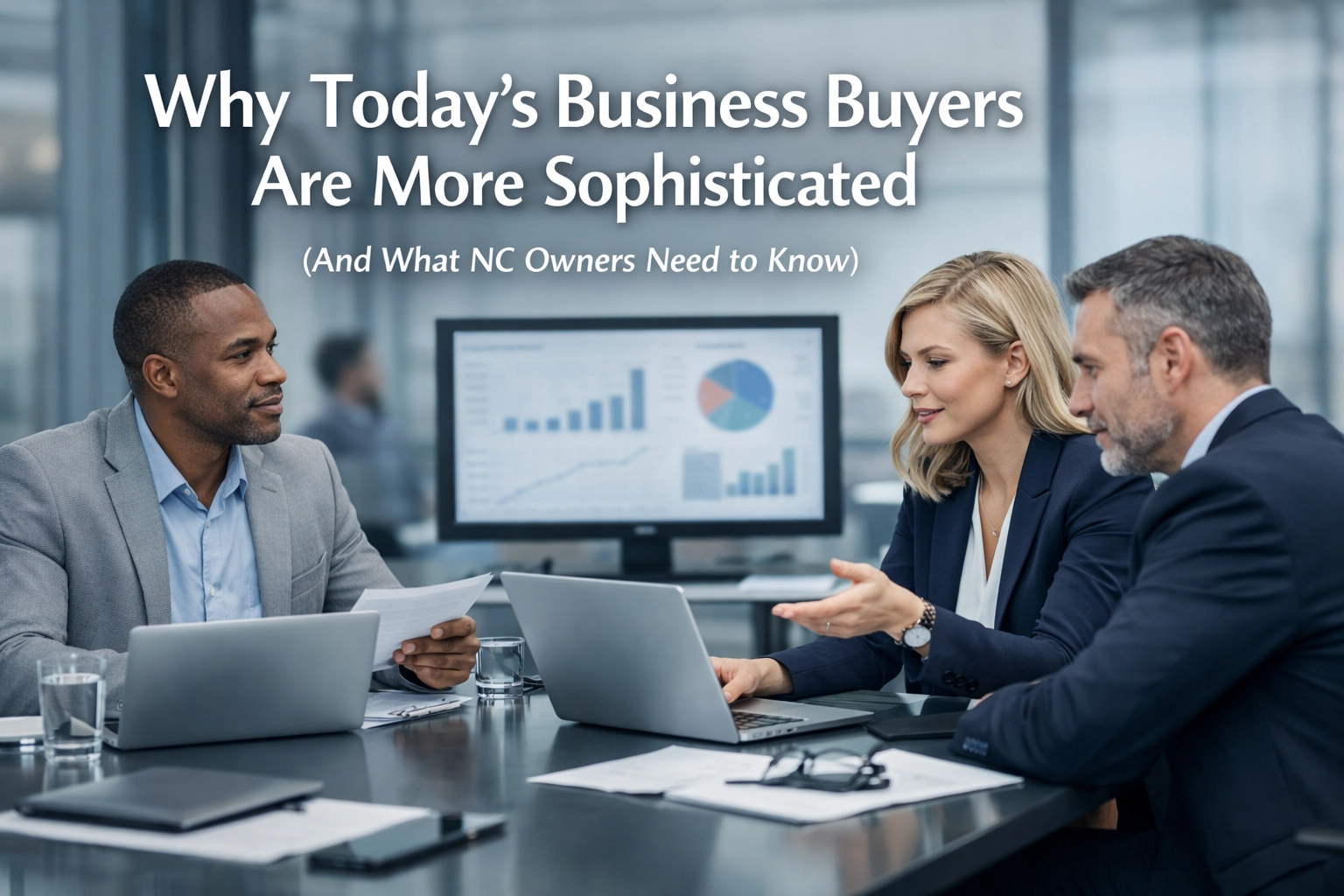
Business buyers today aren't just kicking tires : they're running full diagnostics.
If you're planning to sell a small business in North Carolina, you're walking into a marketplace where buyers arrive armed with data, advisors, and a healthy dose of skepticism.
Here's what I've learned from working with dozens of NC business owners: the gap between what sellers think buyers want and what buyers actually demand has never been wider.
Let me show you what's changed.
The Procurement Committee Has Entered the Chat
Gone are the days when a single buyer showed up, shook your hand, and made an offer based on gut feel.
I worked with a Winston-Salem manufacturing owner last year who was stunned when the buyer brought seven people to the second meeting. A CPA. A lawyer. An operations consultant. A financing advisor. Two family members. And someone whose title was literally "Integration Specialist."

The average business acquisition now involves 13 internal stakeholders and nine external advisors. For complex deals : especially those involving technology systems or multi-location operations : that number doubles.
What this means for you: every claim you make will be scrutinized by multiple experts. Your financials will be dissected by someone who does nothing but analyze EBITDA all day. Your lease terms will be reviewed by a commercial real estate attorney. Your customer contracts will be stress-tested by someone looking for concentration risk.
This isn't paranoia. It's the new normal.
They've Already Googled You (And Your Competitors)
Here's what happens before a serious buyer ever contacts you.
They've run a business appraisal near me search and found three comparable businesses in your market. They've used AI tools to estimate your probable revenue based on employee count and square footage. They've analyzed your online reviews, checked your business license status, and probably driven by your location after hours to see how busy you actually are.
I've watched this firsthand in Raleigh and Charlotte deals. Buyers show up to first meetings knowing things about your business that you didn't realize were publicly visible.
One buyer told me he eliminated three potential acquisitions before ever making contact : all because their Google Business listings showed inconsistent hours and unanswered customer complaints.
The information asymmetry that used to favor sellers? It's gone.
The "Prove It" Economy
Buyers don't believe promises anymore. They want proof.
More than 60% of business buyers now insist on some form of validation period before closing. They want to shadow operations for a week. They want to meet your key employees. They want to talk to your top five customers. They want access to your actual QuickBooks file, not a sanitized P&L summary.

I recently worked with a Greensboro restaurant owner who bristled at this level of scrutiny. "Why don't they just trust the numbers?" she asked.
Here's why: because they've been burned before, or they know someone who has. Because due diligence has become a competitive advantage. Because the cost of a bad acquisition is career-ending for many buyers.
They're not being difficult. They're being smart.
What This Means If You Want to Sell a Small Business
Let's get tactical about what you need to do differently.
Start documentation now, not later. I mean everything. Customer contracts. Vendor agreements. Employee handbooks. Standard operating procedures. Maintenance records. The business that can hand a buyer a complete operations manual on day one immediately stands out from the 80% that can't.
Get a professional valuation done six months before you plan to sell. Not a back-of-napkin calculation : a legitimate business appraisal from someone who understands NC market multiples. This does two things: it tells you if your expectations are realistic, and it provides third-party validation that sophisticated buyers respect.
I work with Vision Fox for exactly this reason : buyers trust external valuations more than seller-provided numbers.
Clean up your books like someone's actually going to read them. Because they are. Separate personal expenses. Reconcile every account. Document any owner compensation that runs through the business. Fix that thing where you've been running your kid's car insurance through the company.

Create a data room before anyone asks for one. Scan everything. Organize it by category. Make it accessible but secure. The business that can provide requested documents within hours instead of days signals professionalism and preparedness.
The Experience Factor Nobody Talks About
Here's something I've noticed working across Durham, Asheville, and the Triangle: buyers increasingly evaluate the experience of buying your business, not just the business itself.
Do you return emails promptly? Are your answers consistent across multiple conversations? Do you seem organized or flustered? Can you articulate why you're selling without sounding desperate?
These soft factors matter more than most sellers realize. I've watched buyers walk away from financially solid businesses because the owner couldn't provide straight answers or kept changing terms mid-negotiation.
Buyers are treating the acquisition process itself as a preview of what working with your customers, vendors, and systems will be like. If dealing with you is difficult, they assume everything else will be too.
The Financing Reality
Interest rates have fundamentally changed buyer behavior. What used to be a casual conversation about SBA loans is now a rigorous analysis of debt service coverage ratios.
Buyers are running multiple scenarios. They're stress-testing your cash flow against higher interest costs. They're looking for businesses that can support debt payments even if revenue drops 15%.
This means your financials need to show consistent, documentable cash flow : not just one good year followed by two mediocre ones. Buyers want to see a three-year trend that proves stability.
In Charlotte, I'm seeing buyers walk away from businesses with volatile earnings, even when the average looks good. Predictability has become more valuable than peak performance.
The Trust Economy
Let me be direct about something: buyers are not trusting AI-generated summaries or marketing materials anymore.
They want to talk to your CPA directly. They want references from industry peers. They want to verify claims through independent sources.
This is actually good news if you've run a legitimate operation. The businesses that suffer are the ones that have been inflating numbers or hiding problems.
If you've got strong relationships with your banker, your landlord, your top customers : lean into those. Third-party validation is worth more than anything you can say about yourself.
What Happens Next
Start preparing your business for sale long before you list it. I'm talking 12-18 months minimum.
Get your documentation in order. Commission a professional valuation. Clean up anything that would make a buyer pause. Build systems that can run without you. Create the kind of transparency that sophisticated buyers demand.
The businesses that sell quickly and at strong multiples aren't necessarily the most profitable ones. They're the ones that make it easy for buyers to say yes : because everything checks out, the story is consistent, and the risk feels manageable.
If you're a North Carolina business owner thinking about an exit in the next few years, request a valuation now. Understanding what buyers will actually pay versus what you hope they'll pay is the first step toward a successful sale.
Share this with another NC business owner who's thinking about selling. The more prepared sellers there are in our market, the better the entire ecosystem functions.