

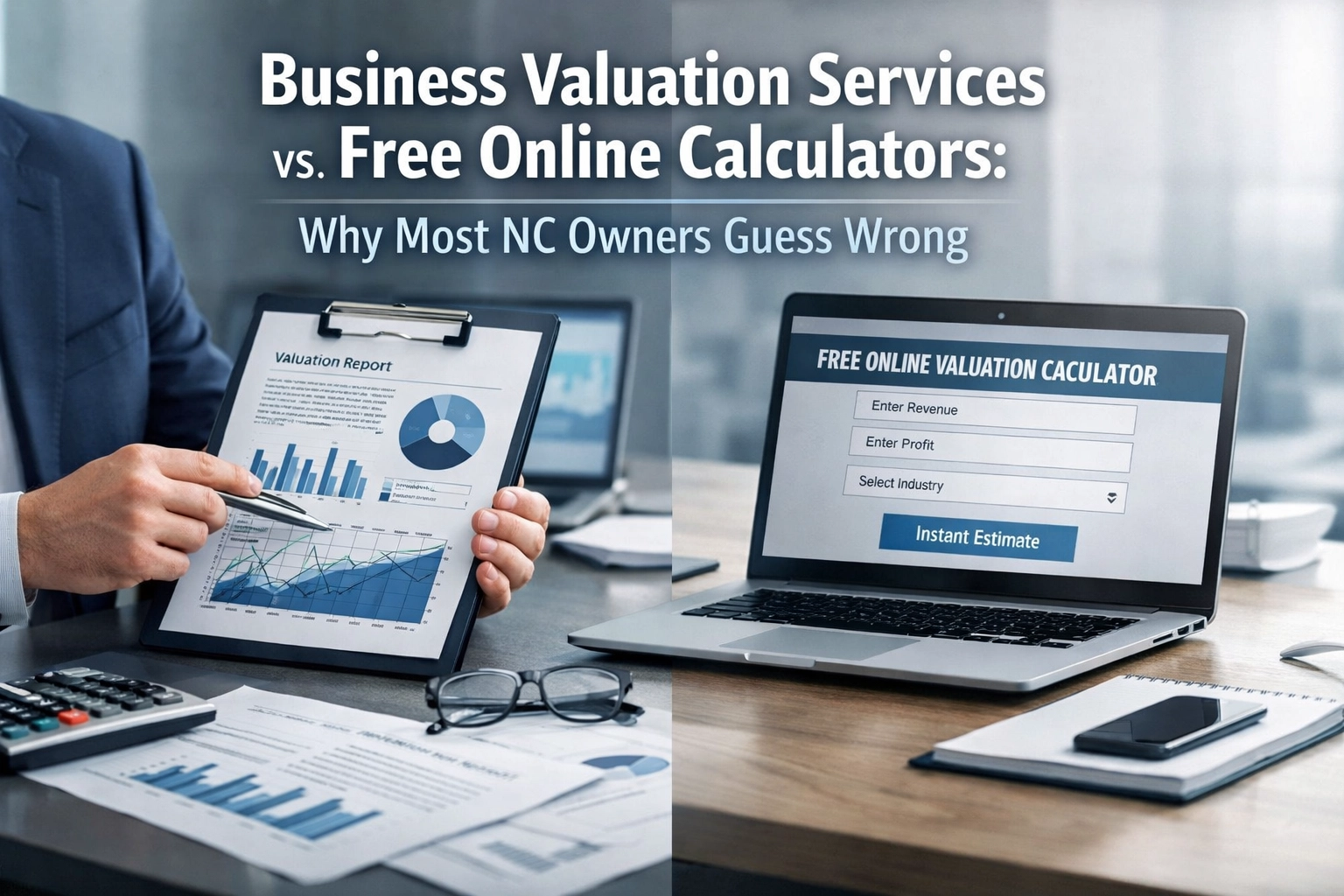
Every business owner I meet in North Carolina wants to know what their company is worth.
Most of them punch their numbers into a free online calculator and walk away thinking they have an answer.
They don't : and that gap between the calculator's number and what buyers actually pay costs North Carolina sellers tens of thousands of dollars every single year.
I've watched this pattern repeat itself in Charlotte, Raleigh, and across the Triangle for years. An owner spends ten minutes with an online tool, gets a number that feels good, and builds their entire exit plan around it. Then reality hits during negotiations.
The calculator said $2.3 million. The offer comes in at $1.6 million.
That's not a negotiation problem. That's a valuation problem.
What Online Calculators Actually Do
Free business valuation calculators perform one function well : they apply industry multiples to your revenue or EBITDA.
You enter your numbers. The algorithm pulls comparable company data. It spits out a range.
The entire process takes five minutes. It feels scientific because there are numbers involved. But what you're getting is a mathematical exercise, not a business appraisal near me that accounts for what your specific company looks like under the hood.

I'm not saying calculators are useless. They give you a starting point : a rough idea of where you might land if everything about your business is average. But most businesses aren't average, and that's where the trouble starts.
What the Calculators Miss Completely
Here's what I've seen happen when owners rely solely on online tools.
Calculators don't look at earnings quality. They take your EBITDA at face value. They don't ask whether that number includes one-time windfalls, whether your add-backs are defensible, or whether a buyer will challenge your normalizations. I worked with a Durham manufacturing company last year that had inflated their discretionary earnings by including the owner's country club dues and a "consulting fee" paid to a relative who didn't work there. The calculator gave them a great number. Buyers laughed at it.
They ignore customer concentration. A Greensboro service company I valued had 68% of their revenue tied to two customers. Both contracts were up for renewal within six months. The online calculator didn't care. It just multiplied revenue by an industry average. But buyers care deeply : and they knocked 30% off the asking price to account for that risk.
They can't measure founder dependency. If you're the rainmaker, the key relationship holder, or the person who knows how everything works : that's a massive risk factor buyers will discount. Online tools have no mechanism to capture this. They assume your business runs itself.
Revenue durability, intangible asset transfers, required capital expenditures, market timing : none of these variables show up in a calculator's formula. But they all show up in buyer due diligence.
Why Professional Business Valuation Services Deliver Different Results
When I perform a valuation through VisionFox, the process looks nothing like what a calculator does.
I start with the same financials : but I normalize them correctly. That means identifying which expenses are truly discretionary, which revenue streams are repeatable, and which costs a new owner will actually face. I've found accounting irregularities, missed liabilities, and inflated projections that would have destroyed deals if they'd surfaced during buyer due diligence instead of during the valuation.
I understand what buyers in your specific market are actually paying. Charlotte buyers behave differently than Wilmington buyers. A professional business valuation doesn't just apply a generic 3x multiple : it considers current market conditions, buyer sentiment in your industry, and which factors are commanding premiums right now versus which are creating discounts.
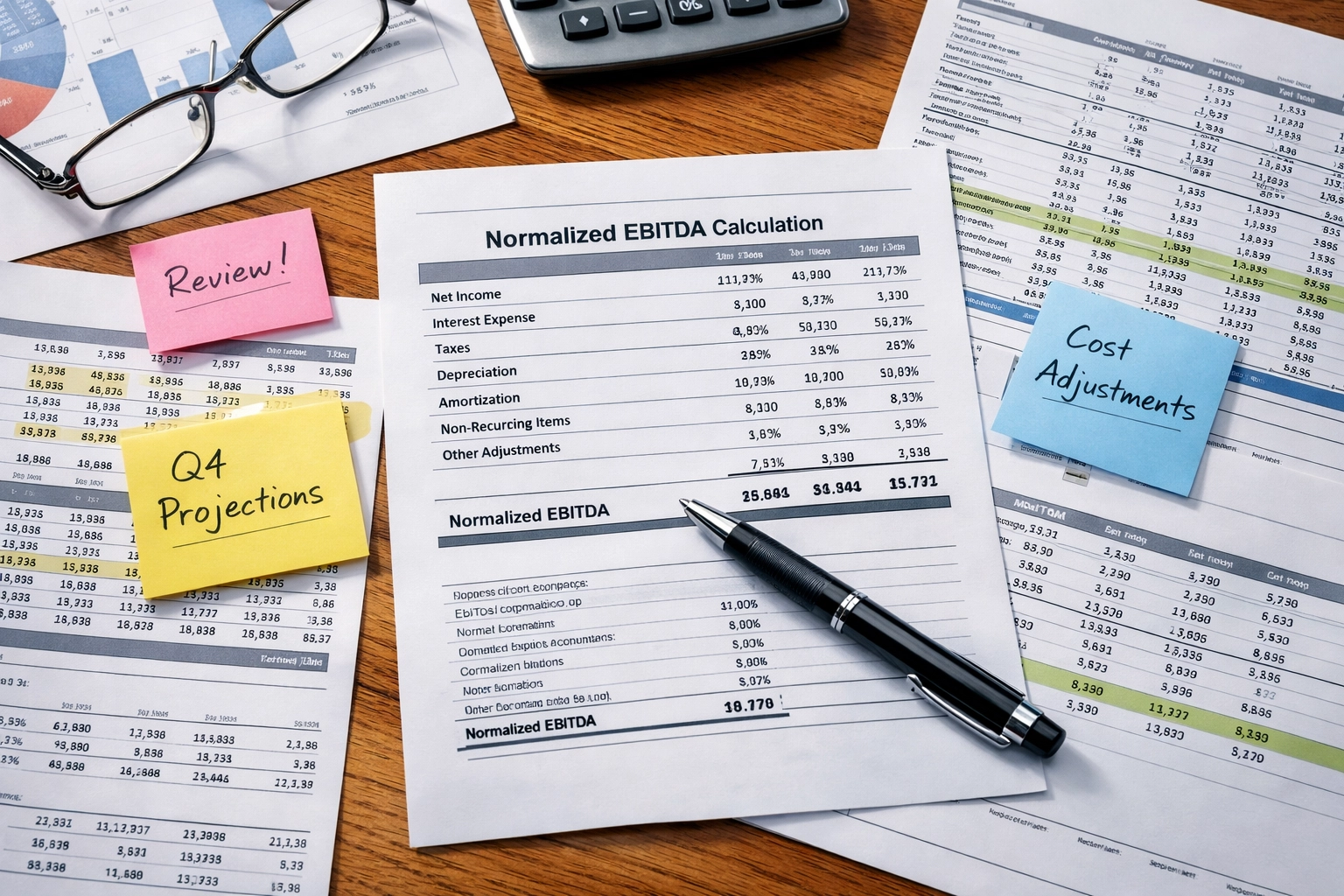
I identify the value drivers that justify premium pricing. Not every business trades at the industry average. Some trade higher because they have proprietary systems, diversified revenue, long-term contracts, or high barriers to entry. Others trade lower because of the risks I mentioned earlier. Calculators can't distinguish between these : they treat every HVAC company or dental practice the same.
The result is a defensible number that survives negotiation and due diligence. When a buyer's accountant starts asking questions, the assumptions hold up.
The Pattern I See in North Carolina
I've worked with business owners across the state : from Asheville to Fayetteville : and the mistake is consistent.
They use a calculator to set their price expectations. They list their business. They receive offers 20-30% below what they anticipated. Then they either accept the lower number feeling defeated, or they dig in and refuse to negotiate, convinced the market is wrong.
Neither outcome serves them well.
Here's what actually happened: The calculator gave them a range based on ideal conditions. But their business had customer concentration, or their financials needed normalization, or their industry was seeing multiple compression, or they had deferred maintenance that buyers would need to address immediately.
Professional business valuation services would have caught these factors upfront. The owner would have either addressed them before going to market : increasing actual value : or priced accordingly and closed faster with realistic expectations.

A Winston-Salem distribution company I worked with last fall illustrates this perfectly. The owner used an online calculator and decided his business was worth $4.2 million. He spent six months entertaining buyers who kept offering $3 million. He couldn't understand the gap.
When we finally did a proper valuation, we found three major issues: outdated equipment that needed immediate replacement, a lease that was expiring with unfavorable renewal terms, and EBITDA calculations that included $180,000 in non-recurring COVID-related government subsidies. Once we normalized the financials and accounted for the required capex, the realistic value was $3.1 million.
He felt frustrated at first : until he realized he'd wasted half a year fighting the market instead of addressing the real issues or pricing correctly from day one.
When Calculators Make Sense vs. When You Need a Professional
Use an online calculator when you're just curious : when you're three years from selling and want a directional sense of where you stand. Use it to understand which levers drive value in your industry. Use it to track progress year over year.
But engage business valuation services when real decisions are on the table.
If you're selling within the next 12-18 months, get a professional valuation. If you're raising capital, bringing in investors, going through a divorce, or dealing with estate planning : get a professional valuation. If you're buying out a partner or setting up a succession plan : get a professional valuation.
The difference in cost is minimal compared to the difference in outcome. I've seen owners in Raleigh and Cary leave six figures on the table because they trusted a free tool over professional analysis. I've also seen owners waste months in failed negotiations because their asking price was disconnected from reality.
Both problems are preventable.
What Changes When You Get the Number Right
When you start with an accurate valuation, the entire sale process shifts.
You price competitively from day one. Serious buyers engage immediately instead of passing because your number seems inflated. Negotiations move faster because there's less gap between expectations and offers. Due diligence goes smoother because your financials are already normalized and your assumptions are already defensible.
You also make better strategic decisions before you list. Maybe you realize you need to reduce customer concentration before going to market. Maybe you discover that investing in new equipment will pay off in multiples during the sale. Maybe you find out your timing is perfect and you should move faster than planned.

All of that insight comes from professional analysis : not from an algorithm that's never seen your books.
If you're in Charlotte or anywhere across North Carolina and you're thinking about your exit, start with real numbers. The calculator might be free, but it's costing you more than you realize.
Request a professional business valuation that shows you what buyers will actually pay : not what an algorithm guesses they might.
Share this with another NC business owner who's thinking about their exit : they're probably making the same calculator mistake right now.